Memory
What sedge remembers between conversations, and how it keeps that accurate.
sedge's memory is a folder of files: ~/.sedge/memory. It follows
The components of agent memory.
What's loaded, and what isn't
MEMORY.mdis loaded into every run, only its first 200 lines (or 25 KB). It's an index: what sedge knows and where to find it, plus anything it needs every time (your standing instructions, current goals). Keeping it short keeps it cheap and keeps it followed.- Everything else in the folder is organized by sedge itself and read when a task calls for it.
- Each agent has its own folder,
memory/agents/<name>/, with its ownMEMORY.md, loaded into its runs instead ofmain's.
What it writes down
sedge is told what memory is for, not a fixed scheme for using it. It writes when you ask it to remember something, or when something is clearly worth keeping: what it couldn't look up again, rules it verified (and how it knows), your preferences, and traps it ran into. It doesn't copy things it can read off the world anyway.
You can tell it directly: "remember that I deploy on Fridays", "forget the old staging URL".
Recall
Every conversation is kept. The recall tool searches all of them, newest first: what you said,
what sedge answered, what tools returned. It's how sedge looks back without having written
everything down.
Dreaming
Notes are written in the moment, and some turn out wrong or go stale. Every night at 03:30 (your
time) sedge dreams: in its own dream conversation, nobody waiting, it reads back over recent
conversations with recall and checks its memory against them. It:
- corrects notes that turned out wrong or out of date;
- merges duplicates and deletes what no longer matters;
- records what it learned and didn't write down;
- keeps
MEMORY.mdsmall, moving details into other files and leaving a link; - does the same for each agent's folder, from that agent's conversations.
If little happened, it changes little. It doesn't message you.
To turn dreaming off, set "dreaming": false in ~/.sedge/config.json and restart the daemon.
Editing it yourself
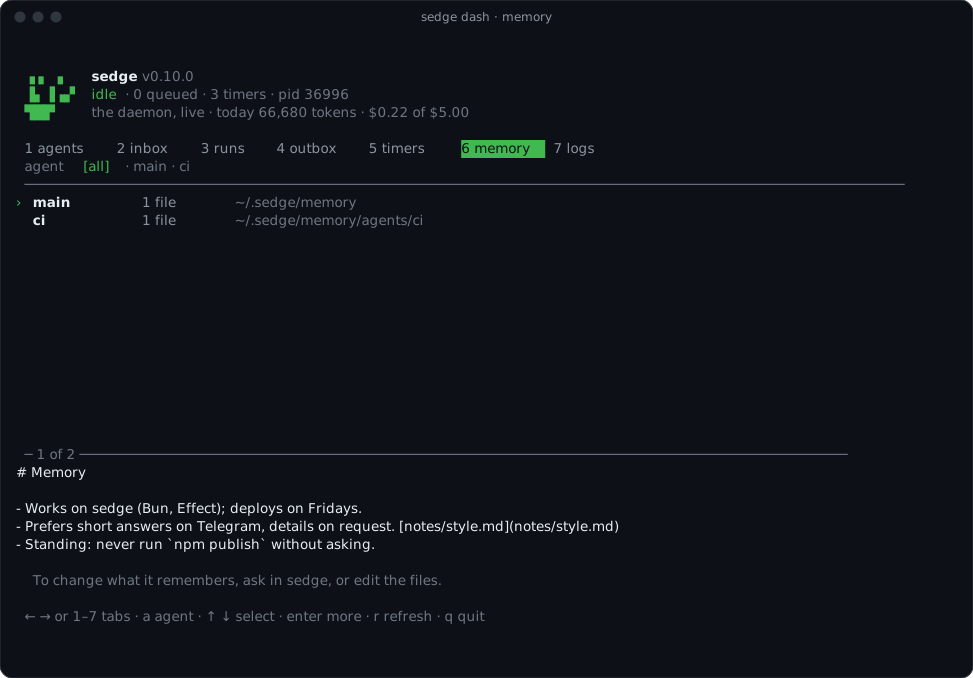
It's your folder. Edit any file; sedge reads it fresh on the next run. /sedge memory shows each
agent's index and files, and in the TUI you can ask the agent to change what one remembers.